

Wisconsin recorded 2,261 hail events over the last ten years, and 1,506 of them dropped stones an inch or larger, the size that cracks shingles, dents metal, and starts an insurance claim.
We pulled ten years of hail reports from the National Weather Service, sorted them by county, and measured how often Wisconsin gets the kind of hail that actually damages a roof. The short version: hail is not a rare event here. It touched all 72 counties, it peaks from May through July, and two out of every three storms were big enough to do real damage.
Here is what a decade of Wisconsin hail looks like.
Key findings
- 2,261 hail events were reported across Wisconsin from 2015 through 2024, an average of 226 a year.
- 1,506 of them (two-thirds) produced hail an inch across or larger. One inch, the size of a quarter, is the point where hail starts damaging asphalt shingles and where most roof insurance claims begin.
- Every one of Wisconsin’s 72 counties recorded hail during the decade. There is no part of the state that sits it out.
- Dane County led the state with 140 hail events. Sawyer County in the northwoods was second with 89, and Waukesha County was third with 77.
- The biggest hailstone on record measured 4.5 inches, about the size of a grapefruit, near Appleton in Outagamie County on September 7, 2021. The National Weather Service called it the largest hailstone measured in Wisconsin in more than 14 years.
- 41 storms dropped hail 2.75 inches or larger, baseball size or bigger.
- Hail is a spring and summer problem. More than half of all events fell in May, June, and July.
- Across hail, damaging wind, and tornadoes, the Weather Service tallied about $176 million in reported property damage over the decade.
Where hail hits hardest in Wisconsin
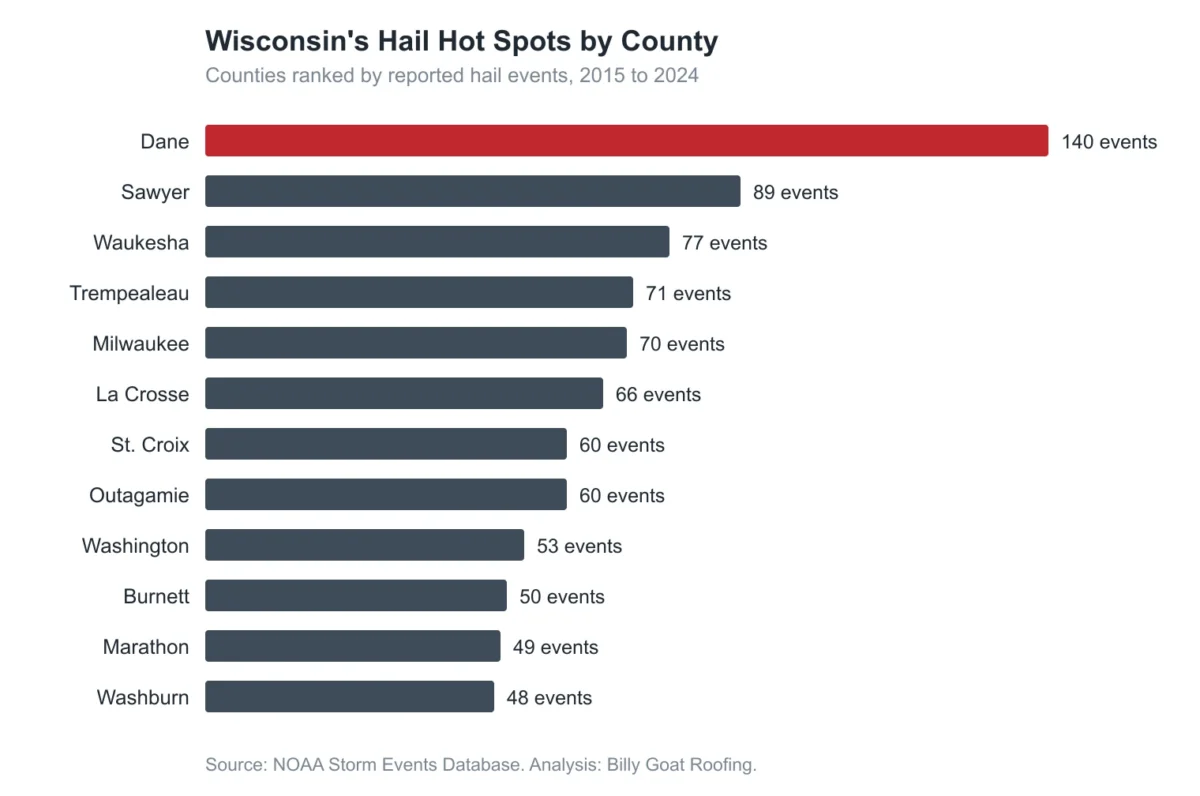
Dane County reported the most hail events of any county in the state, but the top of the list is a mix of dense southern metros and sparsely populated northwoods counties.
That tells you something: this is not just a matter of more people reporting storms in Madison and Milwaukee. Rural Sawyer, Trempealeau, and Burnett counties rank high because they genuinely get hit.
Wisconsin’s hail hot spots by county, 2015 to 2024. Source: NOAA Storm Events Database.
| Rank | County | Hail events (2015-2024) |
|---|---|---|
| 1 | Dane | 140 |
| 2 | Sawyer | 89 |
| 3 | Waukesha | 77 |
| 4 | Trempealeau | 71 |
| 5 | Milwaukee | 70 |
| 6 | La Crosse | 66 |
| 7 | St. Croix | 60 |
| 8 | Outagamie | 60 |
| 9 | Washington | 53 |
| 10 | Burnett | 50 |
| 11 | Marathon | 49 |
| 12 | Washburn | 48 |
| 13 | Wood | 45 |
| 14 | Walworth | 43 |
| 15 | Price | 42 |
For the Milwaukee area specifically: the seven-county metro (Milwaukee, Waukesha, Washington, Ozaukee, Racine, Kenosha, and Walworth) recorded 311 hail events over the decade. Waukesha County alone ranked third in the entire state, and Milwaukee County fifth. If you own a home in southeastern Wisconsin, hail is a when, not an if.
Two out of three storms can damage a roof
Not all hail matters to a roof. Pea-size and marble-size hail bounces off asphalt shingles without leaving a mark. The trouble starts at about one inch across, the size of a quarter.
That is the point where hail begins fracturing shingle mats, knocking granules loose, and denting metal flashing, vents, and gutters. It is also the size most insurance adjusters treat as the threshold for a legitimate roof claim.
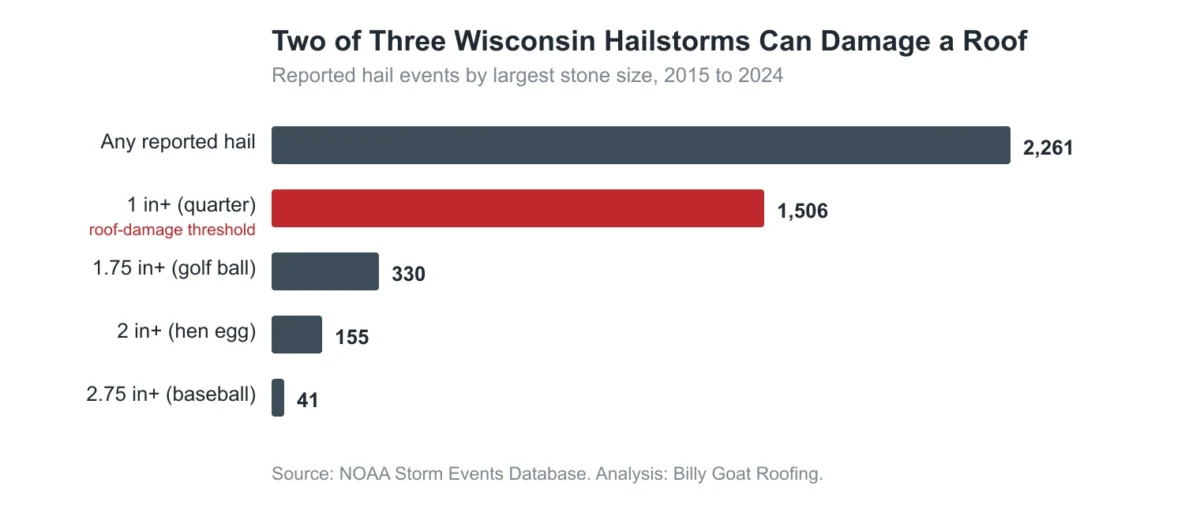
Of the 2,261 hail events in Wisconsin over the decade, 1,506 reached that one-inch mark or bigger. That is two out of every three storms.
Reported Wisconsin hail events by largest stone size. Source: NOAA Storm Events Database.
| Hail size | Everyday comparison | Wisconsin events (2015-2024) |
|---|---|---|
| Any reported hail | All sizes | 2,261 |
| 1.00 inch or larger | Quarter | 1,506 |
| 1.75 inch or larger | Golf ball | 330 |
| 2.00 inch or larger | Hen egg | 155 |
| 2.75 inch or larger | Baseball | 41 |
The damage does not always show up right away. Hail bruises can break the seal on a shingle and let water in months later, which is why a roof that looks fine from the ground can still be leaking by the next season. After a storm with quarter-size hail or bigger, it is worth having the roof looked at.
The biggest hailstones of the decade
The largest stone Wisconsin recorded in ten years fell near Appleton on September 7, 2021, and measured 4.5 inches across, roughly a grapefruit. That morning, supercells rolled down the Interstate 41 corridor and dropped golf-ball to softball hail across Waupaca, Outagamie, and Brown counties, breaking windows and denting roofs from New London to southern Brown County.
The other standout was August 2, 2015, when a line of storms dropped four-inch hail across Oconto County and three-inch stones as far south as Milwaukee County.
| Size | County | Nearest town | Date |
|---|---|---|---|
| 4.5 in | Outagamie | Apple Creek (Appleton area) | Sept 7, 2021 |
| 4.1 in | Outagamie | Greenville | Sept 7, 2021 |
| 4.0 in | Oconto | Abrams | Aug 2, 2015 |
| 4.0 in | Oconto | Brookside | Aug 2, 2015 |
| 4.0 in | La Crosse | Neshonoc Lake area | Jul 28, 2023 |
| 3.75 in | Waukesha | Mukwonago | Aug 2, 2015 |
| 3.75 in | Outagamie | Little Chute | Sept 7, 2021 |
| 3.5 in | Trempealeau | Trempealeau | Jul 6, 2017 |
| 3.0 in | Milwaukee | St. Martins | Aug 2, 2015 |
| 3.0 in | Wood | Rudolph | Aug 2, 2015 |
When Wisconsin gets hail
Hail season in Wisconsin runs from spring into late summer. May, June, and July accounted for more than half of every hail event in the decade, with July the single busiest month. That timing lines up with the warm, unstable air that fuels the strongest thunderstorms.
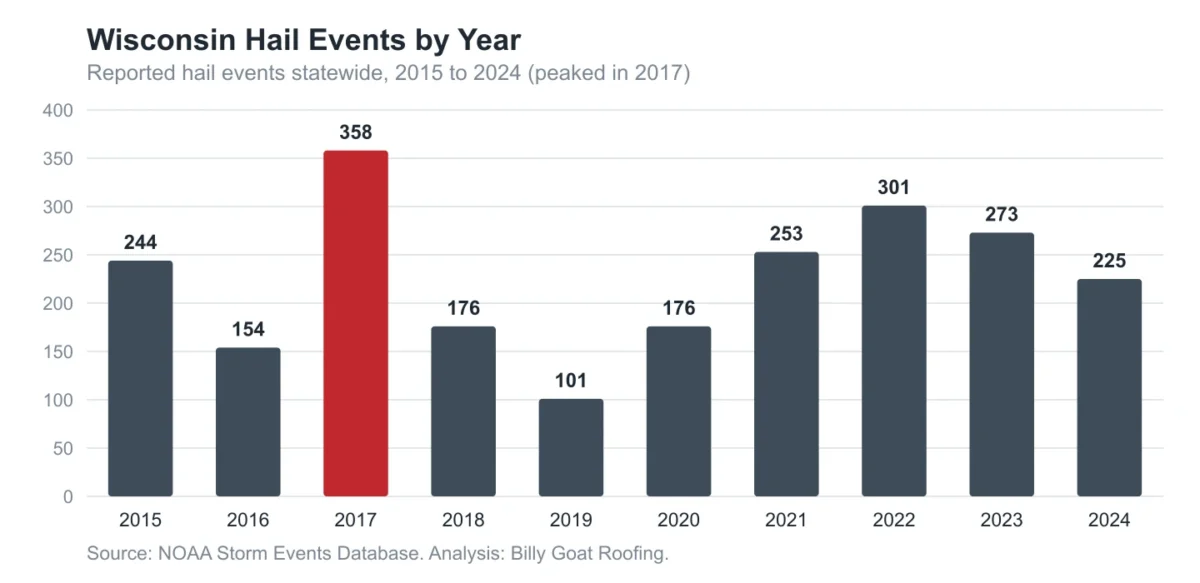
Year to year, the counts swing a lot. 2017 was the busiest year with 358 hail events statewide, while 2019 was the quietest with 101. A calm year does not mean the risk is gone, it just means the storms lined up somewhere else.
Wisconsin hail events by year. Source: NOAA Storm Events Database.
Hail is not the only threat to a Wisconsin roof
Hail gets the attention, but two other storm types in the same dataset do plenty of roof damage:
- Damaging thunderstorm winds were reported 3,187 times over the decade, more often than hail. The strongest gust on record reached about 110 miles per hour in Fond du Lac County on August 28, 2018. High winds lift and tear shingles, drive rain under the roofing, and bring down limbs.
- Tornadoes touched down 309 times. Most were on the weaker end of the scale, but three reached EF3 strength, and together they injured 32 people.
Add it all up and Wisconsin’s severe storms caused roughly $176 million in reported property damage over ten years. That figure almost certainly understates the true cost, because the Weather Service damage estimates do not capture every insured roofing loss.
Methodology
The numbers on this page come from the NOAA Storm Events Database, the official federal record of severe weather compiled by the National Weather Service. We downloaded the complete event details files for 2015 through 2024 and filtered to Wisconsin.
- Geography: county-based events in Wisconsin. The database also logs some events by forecast zone, which we excluded so every event maps to a single county.
- Event types: hail is the focus. Damaging wind (thunderstorm wind) and tornadoes are reported separately in the secondary section.
- Hail size is the diameter of the largest stone reported for each event, in inches, as recorded by trained spotters, the public, and Weather Service staff.
- County counts reflect reported events. Reporting depends on people seeing and calling in hail, so a county with more spotters may look slightly busier than a remote one. Even so, several rural counties rank near the top, which points to genuine hail frequency rather than reporting alone.
- Property damage figures are the Weather Service’s estimates at the time of each event and undercount total insured losses.
- The biggest hailstones were cross-checked against National Weather Service event summaries, including the September 7, 2021 hail event near Appleton.
The analysis script is re-run each year as the Weather Service finalizes new data, so this page updates over time.
What this means if you own a Wisconsin home
Hail is a normal part of owning a home here, not a freak event. Over ten years, two out of every three Wisconsin hailstorms were strong enough to damage a roof, and every county in the state got hit. The practical takeaways are simple:
- After a storm with quarter-size hail or larger, get the roof inspected. Damage is often invisible from the ground, and hail bruises can turn into leaks a season or two later.
- Do not wait until it leaks. Most policies have a window for filing hail and wind claims, and a documented inspection right after a storm makes the claim far easier.
- Know your county’s history. If you are in Waukesha, Milwaukee, Washington, or anywhere else near the top of the list, budget for the reality that your roof will take hail at some point.
Billy Goat Roofing is a local, fully insured roofing contractor serving the greater Milwaukee area.
We handle storm and hail damage roof repair from the first inspection through the insurance claim, and we install and replace residential roofs built to stand up to Wisconsin weather.
If a storm has come through your neighborhood, call today for a free inspection at 414-426-7885.
Cite this study
This research is free to cite and share. Please credit Billy Goat Roofing and link back to this page.
Source: Billy Goat Roofing analysis of NOAA Storm Events Database records, 2015 to 2024.
For questions about the data or a copy of the underlying figures, contact Billy Goat Roofing.
Last updated: July 2026. Data covers 2015 through 2024 and is refreshed as the National Weather Service finalizes new years.